MURAL PAINTING
Mural Gallery
Painting Decoration
What is Trompe L'oeil?
Mural Painting & History
Mural Painting Timeline
Trompe L'oeil Mural
Easy Painting Technique
Trompe L'oeil Mural Preparation & Painting Tips
Painting Terms


Renaissance Ceiling
Ceiling Decoration and Trompe l'Oeil Murals

Renaissance Decoration are paintings and designs describing the period of European artistic history from the early 14th to the late 16th century, with the masters of the Renaissance - Leonardo da Vinci, Michelangelo Buonarotti and Raphael Sanzio. The word renaissance is derived from the Frence word for rebirth & originally referred to the revival of the values, artistic styles of classical antiquity during that period, especially in Italy.


Ceiling Paintings of Michelangelo Buonarotti

Sistine ceiling painting, the most complex composition in western art is painted by renaissance master Michelangelo Buonarotti. He is the greatest and universally viewed as the supreme Renaissance artist. He created monumental works of painting, sculpture and architecture.


The Creation of Adam : a Project

Decorative Ceiling Trompe l'Oeil
by Richard Ancheta

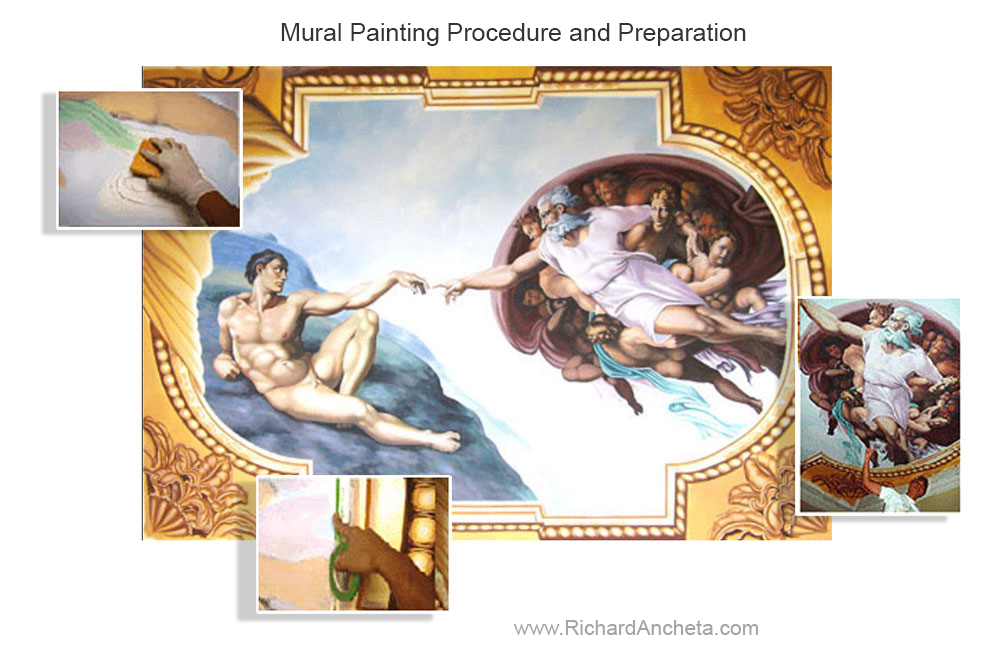
Recently I had the good fortune of dealing with a flexible client who ask me to paint the Michelangelo's masterpiece, the concept and the theme is exciting, the renaissance figure painting was rare and intricate.


Renaissance Ceiling Renaissance Ceiling
The Creation of Adam - Trompe l'Oeil Ceiling 163.75" x 109.5"


This project requires a trompe l'oeil effect, an illusion of depth as you were in the worms eyeview. I began working on the concept by creating sketches of ceiling designs referring the works of the master of trompe l'oeil, the classic Graham Rust. The ceiling and the balcony design was harmonize and follow the rhythm figure composition of Adam same as the swirling draperies of the God and cherubim. I used a series of browns and yellow ocre as a monochromatic rendition to separates the painting and the ceiling. The decoration gives a classic aura of the renaissance spirits and value.

The Story Behind the Painting:

The Creation of Adam
is a fresco on the ceiling of the Sistine Chapel, painted by Michelangelo Buonarroti circa 1511. It illustrates the Biblical story from the Book of Genesis in which God the Father breathes life into Adam, the first man. Chronologically the fourth in the series of panels depicting episodes from Genesis on the Sistine ceiling, it was among the last to be completed. It is arguably one of the most famous and most appreciated images in the world.

God is depicted as a bearded old man wrapped in a swirling cloak that he shares with some cherubim. His left arm is wrapped around a female figure, normally interpreted as Eve, who is not yet created and, figuratively, waits in heaven to be given an earthly form. God's right arm is outstretched to impart the spark of life from his own finger into that of Adam, whose left arm is extended in a pose mirroring God's. Famously, Adam's finger and God's finger are separated by a slight distance.

The composition is obviously artistic and not literal, as Adam is capable of reaching out to God even before he has actually been given "life." For this same reason, Eve is visually depicted prior to her own creation, although this has led a few people to believe the female figure must be Adam's mythical first wife, Lilith; however, this interpretation makes no more literal sense since Lilith was also created after Adam.

The similar poses of God and Adam - the positions of God's right leg and Adam's left are, for instance, nearly identical - reflect the fact that, according to Genesis 1:27, God created man in His own image. At the same time God, who is airborne and appears against ovoid drapery, is contrasted with earthbound Adam, lying on a stable triangle of barren ground (Adam's name comes from a Hebrew word meaning "earth").

The inspiration for Michelangelo's treatment of the subject may come from a medieval hymn called Veni, Creator Spiritus, which asks the 'finger of the paternal right hand' (digitus paternae dexterae) to give the faithful speech, love and strength.

Adam's index finger, the most famous in Western art alongside God's, is in fact not the work of Michelangelo. It was damaged beyond repair by a crack that appeared in the ceiling in the mid-16th century and was repainted by a papal restorer.


Main | Decorative | Portraiture | Advertising | The Artist | Contact Us | Shop Online |
Trompe L'oeil | Mural Painting | Renaissance Ceiling | Wall & Column Marbling | Signage | Hand Painted Furniture
Oil Portraits | Portrait from Photographs | Charcoal Portrait | Watercolour Portrait | Framing
Figurative & Neo Classical Paintings | Animal Paintings | Dog Paintings | Cat Paintings | Bird Paintings
Botanical & Floral
| Landscape & Seascape | Marine Painting | Dragon Designs | Illustrations


Screen Resolution:800 x 600 pixels
Updated Feb. 12, 2008

All Rights Reserved. Artist works, scans protected by Copyright ©2007
Atelier Ancheta, Montreal Canada

www.RichardAncheta.com

Visit ArtistsInCanada.com, a national directory of Canadian artists and art resources