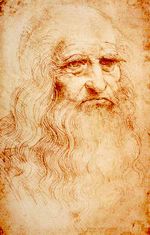
Leonardo
da Vinci. He has been described as the archetype of the
"Renaissance man", a man infinitely curious and equally
inventive. He is widely considered to be one of the greatest
painters of all time.
The life and work of the great Italian Renaissance artist
and scientist Leonardo da Vinci have roved endlessly fascinating
for later generations. What most impresses people today,
perhaps, is the immense scope of his art and art theory.
Leonardo's equally impressive contribution to science is
a modern discovery, having been preserved in a vast quality
of notes that became widely known only in the 20th century.
LIFE
Leonardo was born on April 15, 1452, near the town of Vinci,
not far from Florence. He was the illegitimate son of a
Florentine notary, Piero da Vinci, and a young woman named
Caterina. His artistic talent must have revealed itself
early, for he was soon appreciated (c.1469) to Andrea Verrocchio,
a leading renaissance master. In this versatile Florentine
workshop, where a variety of skills. He entered the painter's
guild in 1472, and his earliest extant works date from this
time. In 1478 he was commissioned to paint and altarpiece
for the Palazzo Vecchio in Florence. Three years later he
undertook to paint Adoration of the Magie for the monastery
of San Donato a Scopeto. This project was interrupted when
Leonardo left Florence for Milan about 1482. Leonardo worked
for Duke Lodovico Sforza in Milan for nearly 18 years. Although
active as court artist, painting portraits, designing festivals,
and pro jecting a colossal equestrian monument in sculpture
to the duke's father, Leonardo became deeply interested
in non-artistic matters during this period. He applied his
growing knowledge of mechanics to his duties as a civil
and military engineer, biology, mathematics, and physics.
These activities, however, did not prevent him for completing
his single most important painting, The Last Supper.
With the fall (1499) of Milan to the French, Leonardo left
that city to seek employment elsewhere: he went first to
Mantua and Venice, but by April 1500 he was back in Florence.
His stay there was interrupted by time spent working in
central Italy. as a mapmaker and military engineer for Cesare
Borgia. Again in Florence in 1503. Leonardo undertook several
highly significant artistic projects, including the Battle
of Anghiari mural for the council chamber of the Town Hall,
the portrait of Mona Lisa and the lost and the Swan. At
the same time his scientific interests deepened: his concern
with anatomy led him to perform dissections, and undertook
a systematic study of the flight of birds.
Leonardo returned to Milan in June 1506, called there to
work for the new French government. Except for a brief stay
in Florence (1507-08), he remained in Milan for seven years.
The artistic project on which he focused at this time was
the equestrian monument to Gian Giacomo Trivulzio, which,
like the Sforza monument earlier, was never completed. Meanwhile,
Leonardo's scientific research began to dominate his other
activities, so much so that his artistic gifts were directed
toward scientific illustration; through drawing he sought
to convey his understanding of the structure of things.
In 1513 he accompanied Pope Leo X's brother, Giuliano de'Medici,
to Rome, where he stayed for three years, increasingly absorbed
in theoretical research. In 1516-17, Leonardo left Italy
forever to become architectural advisor to King Francis
I of France, who greatly admired him. Leonardo died at the
age of 67 on May 2, 1519, at Cloux, near Ambroise, France. |
Masterpiece
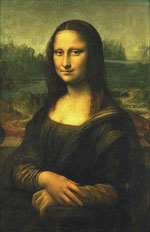
The
Mona Lisa, Oil Painting, 77 x 53 cm (30 x 20 7/8 in) (Louvre,
Paris), also known as La Gioconda, is a portrait
of the wife of Francesco del Giocondo, painted by Leonardo
da Vinci between 1503 and 1505. This figure of a woman dressed
in the Florentine fashion of her day and seated in a visionary,mountainous
landscape, is a remarkable instance of Leonardo's sfumato
technique of soft, heavily shaded modeling. Sfumato is the
famous invention of Da Vinci - light and shade that allow
one form to blend in with another leaving something to the
imagination. He did this to the corners of Mona Lisa' mouth
and eyes which explains why she may look different and different
times. The Mona Lisa's enigmatic expression, which seems
both alluring and aloof, has given the portrait universal
fame. |